
Why Soft, Black, Reflective and Transparent Parcels Are Hard to Measure
Learn why soft, black, reflective and transparent parcels challenge 3D dimensioning, and how to design representative tests and exception workflows.
Sep 28,2026 | Jasper Lee
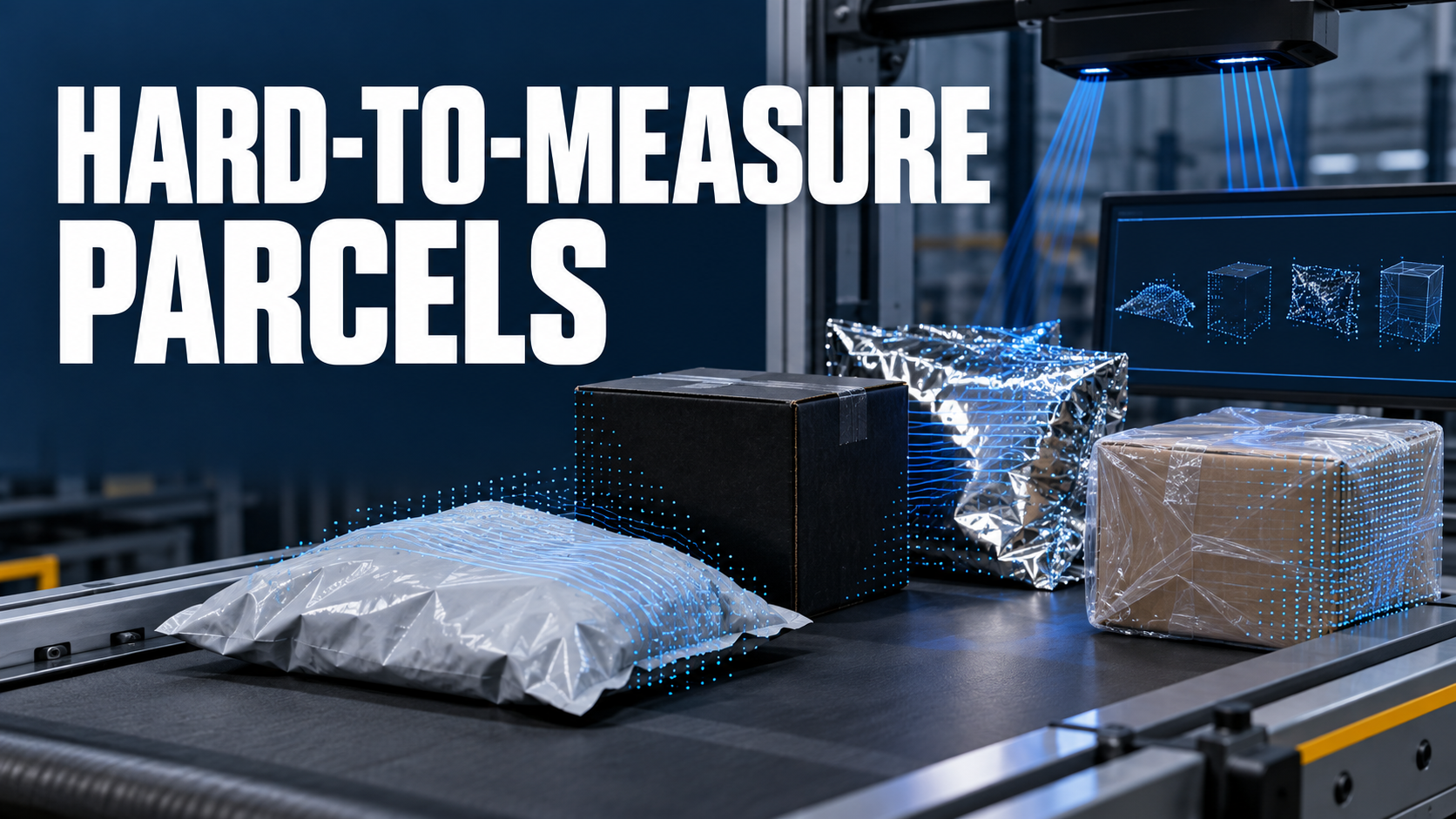
Direct answer: Soft, black, reflective and transparent parcels are difficult to dimension because they violate different sensing assumptions. Soft packaging changes shape under handling, dark material can return weak optical energy, specular surfaces redirect light away from or between sensors, and transparent material can reveal the background instead of a stable outer surface.
CONLIDA is a DWS specialist focused on parcel dimensioning and physical logistics data capture. The engineering goal is not to claim that one sensor measures everything; it is to define the validated application envelope and control what happens outside it.
Why soft parcels produce unstable dimensions
A poly mailer or loosely filled bag has no single rigid cuboid boundary. Its highest point can move when contents settle, air escapes or a conveyor belt flattens the package. Creases may create local peaks while overhanging film changes the apparent footprint. Two correct measurements can therefore differ because the object itself changed.
The workflow must define presentation: free-standing or flattened, seams included or excluded, minimum settling time, orientation and whether a bounding box or another rule is required. Without that definition, “accuracy” is being compared against an unstable reference.
Why black materials can lose depth data
Many active optical systems illuminate the object and estimate distance from returned light. Very dark surfaces absorb more of that energy, reducing signal strength. In stereo systems, featureless black areas may also provide too little visible texture for reliable correspondence. The result can be missing points, noisy edges or lower confidence rather than an obviously wrong rectangular box.
Sensor technology, wavelength, exposure strategy, working distance and ambient light all matter. A dark sample that works at one distance or speed does not automatically validate every black parcel in production.
Why reflective surfaces create false geometry
A matte surface scatters light in many directions. A glossy or metallic surface behaves more like a mirror: light may be directed away from the receiver, saturate part of the image or bounce between surfaces before returning. Basler documents multipath as a source of false distance because the received light travelled a longer route than the direct path.
Reflective tape, foil bags and glossy shrink wrap can create small high-intensity regions next to weak regions. A system may need multiple views, confidence filtering, exposure control or a defined exception when the outer boundary cannot be reconstructed reliably.
Why transparent packaging reveals the wrong surface
Transparent material can transmit illumination to the contents, belt or background. Zivid notes that a standard structured-light pipeline may miss the transparent surface or place points on what lies behind it. Clear wrap can also add specular reflections and double surfaces, especially around folds and curved areas.
The business question is important: should the record describe the invisible clear outer wrap, the contained product or a handling envelope? That rule must be explicit before a test can have a meaningful expected answer.
Why shape and surface problems combine
Real parcels rarely present one isolated difficulty. A soft black mailer may be absorptive, textureless, deformable and wrinkled. A clear bag can be glossy and contain irregular objects. The probability of incomplete coverage grows when weak return, occlusion and changing geometry occur together.
Engineering test matrix
| Parcel class | Primary risk | Representative test variable | Required control |
|---|---|---|---|
| Soft mailer | Shape changes | Fill level, orientation, settling | Presentation rule and repeatability check |
| Matte black carton | Weak return or low texture | Distance, speed, ambient light | Confidence threshold and coverage rule |
| Reflective foil | Saturation or multipath | Angle, wrinkles, adjacent surfaces | Multi-view validation or exception |
| Clear wrap/container | Background measured as surface | Contents, belt color, folds | Defined business boundary and review route |
Do not hide difficult items inside an average
A high overall acceptance rate can conceal systematic failure on a commercially important parcel class. Report results by material, shape, size, orientation and operating condition. Retain a quality state with each event so the WMS or shipping workflow can separate accepted measurements from incomplete, low-confidence or manual-review records.
CONLIDA Engineering Note
The best difficult-item test set is built from operational consequences, not from a visually interesting sample shelf. Start with the parcel classes that cause billing corrections, manual rework, conveyor stops or master-data disputes. Then preserve those exact classes as a regression set after every sensor, software or layout change.
Implementation checklist
- Classify difficult parcels by shape, surface and business frequency.
- Define the intended outer boundary for each class.
- Test positions, orientations and production conditions.
- Measure coverage and quality state, not only final dimensions.
- Create physical and digital routes for rejected observations.
- Retain examples as a commissioning and regression library.
Topic cluster and next step
- Parent concept article: How Does a Parcel Dimensioner Work?
- Related technical article: How to Measure Irregular Parcels
- Next-step buyer article: Questions to Ask a DWS Supplier
- Relevant solution/use case: Review difficult parcel samples with CONLIDA
Sources
- Basler — Time-of-flight influencing factors
- Zivid — Dealing with transparent objects
- Luxonis — Stereo depth scene texture
- OIML R 129-1:2020
Related Questions
Can a parcel dimensioner measure black boxes?
Many systems can, but performance depends on the sensing method, reflectivity, working distance, ambient conditions and required coverage. Representative testing is still necessary.
Why do repeated measurements of a soft bag differ?
The bag may change shape as contents settle, air moves or the belt supports it differently. A consistent presentation and boundary rule is required.
Can transparent parcels be measured automatically?
Sometimes, with an appropriate technology and controlled setup. The expected outer boundary and exception rule must be defined because sensors may see contents or background through the material.
Should failed point clouds be discarded?
They should not become authoritative measurements, but retaining quality codes and selected evidence helps diagnose recurring parcel classes and improve the workflow.
Comment